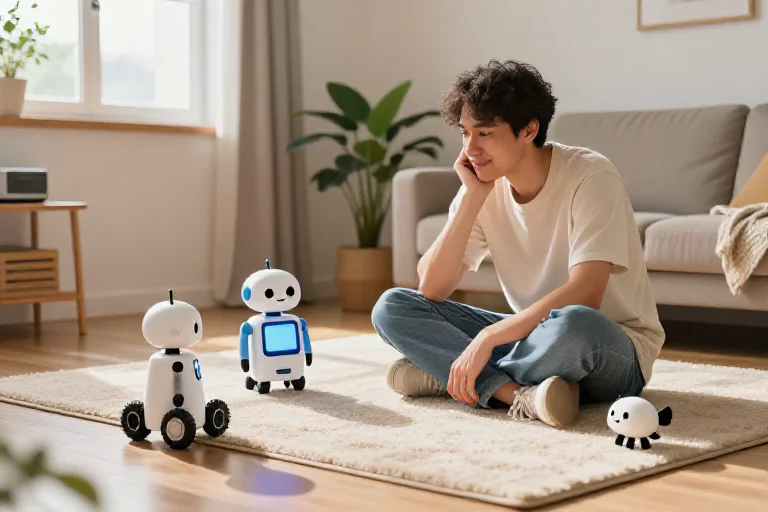
Buying your first AI desktop robot is a little different from buying headphones or a keyboard.
With those products, you usually know what you're buying.
You want better sound.
You want a better typing experience.
Simple.
Robots are messier.
A small robot can be:
a toy,
a companion,
an AI interface,
a programmable machine,
or just something you think is incredibly cute.
Sometimes it's several of those things at once.
That's why I wouldn't start with the specs.
I'd start with yourself.
What do you actually want the robot to do?
This sounds obvious.
It isn't.
You might say:
"I want an AI robot."
But what does that actually mean?
Do you want to talk to it?
Do you want it to move around?
Do you want something that feels like a pet?
Do you want something fun to watch?
Do you want something you can customize?
Do you want it to help with everyday tasks?
Those are different products.
If you mainly want conversation
Then prioritize the interaction experience.
Look at:
- voice quality
- how naturally it responds
- whether it can hear you reliably
- personality
- visual interaction
- memory
- how often you actually want to talk to it
A robot doesn't become a good companion just because it has an LLM behind it.
The interaction has to feel natural enough that you actually want to use it.
If you mainly want physical fun
Then look at the body.
Can it move?
Where can it move?
Can it interact with objects?
Can it react to its surroundings?
Can you control it?
Does it have enough physical behavior to stay interesting?
MicroDuck is a good example of this type.
Its current behavior set includes walking, rolling, grasping, sitting, kicking, and recovery. (Pollen Robotics)
If that is the part that excites you, a conversational robot might actually disappoint you.
If you want a robot pet
Then I would pay much more attention to personality than technical capability.
Ask:
Does it feel pleasant to have around?
Does it react in interesting ways?
Do I enjoy interacting with it when I don't need anything?
Does it feel like something I could become familiar with?
These questions sound less technical.
They're actually more important for companionship.
If you want usefulness
This is where I'd be the most careful.
A lot of AI robot demos are impressive because you can imagine ten different things the robot might eventually do.
But you shouldn't buy based on all ten.
Ask:
What can it do today that I would actually use?
If the answer is nothing, don't invent a reason to buy it.
A robot can be exciting without being useful.
That's fine.
Just don't pay for utility you're imagining rather than utility you're getting.
If you like experimenting
Then openness and customization matter more.
MicroDuck, for example, publishes its SDK, simulation environment and reinforcement-learning training stack openly. (Pollen Robotics)
That doesn't mean you have to become a developer.
It just means the robot leaves more room for people who want to explore deeper.
But again, that's a different reason to buy.
The biggest mistake is buying the wrong experience
Imagine wanting:
"a little robot that keeps me company."
and buying a robot because it has amazing mobility.
Or wanting:
"a robot I can teach."
and buying one that is mostly a finished companion.
Or wanting:
"something fun for my desk."
and buying an expensive device that requires constant setup.
That's how people end up saying:
"The product is good, but I don't really like it."
The product may not be the problem.
The expectation is.
My simple checklist
Before buying, answer these four questions:
What do I want to do with it?
Not what can it theoretically do.
What do I want to do?
What would make me keep it on my desk?
Fun?
Conversation?
Personality?
Useful features?
How much effort am I willing to put in?
None?
A little?
A lot?
What if the robot never becomes more capable?
This is the hardest one.
If the current product is already interesting enough, great.
If you're only excited about what it might become, slow down.
This is also why I don't think there is a "best AI desktop robot"
There is only the robot that best matches what you want.
A robot that is perfect for someone who wants companionship may be boring to someone who wants movement.
A robot that is perfect for someone who wants to experiment may be frustrating to someone who just wants something easy.
That's why the question:
"Which robot is best?"
is usually less useful than:
"Which robot is best for me?"
Start there.
Everything else gets easier.
