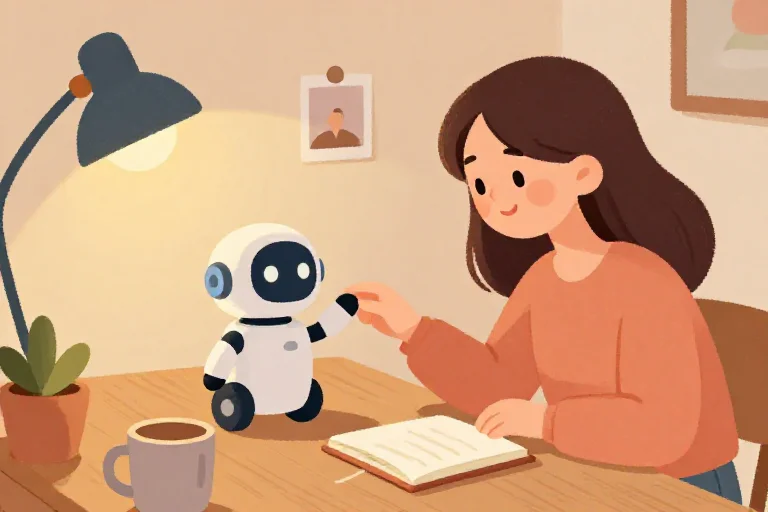
Cuteness is powerful.
It can make you stop scrolling.
It can make you send a robot video to a friend.
It can make you say:
"I want one."
But I don't think cute is enough to build a great desktop robot.
It is probably the beginning of the relationship, not the whole thing.
The honeymoon period is easy
Imagine putting a new robot on your desk.
The first day is exciting.
You watch it move.
You try every behavior.
You talk to it.
You see what happens when you touch it.
You show someone else.
Maybe you make a video.
The second day is still fun.
A week later, the situation becomes very different.
You've already seen it walk.
You've already heard its sounds.
You already know what happens when you ask it something.
Now what?
This is the problem every consumer robot has to solve.
Not:
Can I make people interested?
But:
Can I make people care after the novelty disappears?
I think there are several stages of value
A useful way to think about a desktop robot is:
Interesting → Fun → Personal → Useful
The order matters.
You probably don't need all four on day one.
But the further a robot can move through that sequence, the harder it becomes to replace with a simple gadget.
Stage one: Interesting
This is where appearance matters.
A robot can simply look different.
Maybe it has an unusual design.
Maybe it moves in a funny way.
Maybe it looks like a tiny animal.
Maybe it has a face.
Maybe you've never seen anything quite like it.
This is enough to create curiosity.
And curiosity is valuable.
But curiosity has a short shelf life.
Stage two: Fun
Now the robot actually gives you something to do.
You can interact with it.
Maybe it plays games.
Maybe it reacts to you.
Maybe it moves around.
Maybe you can teach it something.
Maybe there are new behaviors to discover.
This is where movement becomes especially important.
A static object can be cute.
A moving object gives you something to watch.
A responsive object gives you something to interact with.
That can keep the novelty alive longer.
But even fun has a limit.
You eventually need another reason to care.
Stage three: Personal
This is the interesting one.
At some point, the robot stops being:
"the robot I bought"
and starts becoming:
"my robot."
That sounds subtle, but it changes the relationship.
Maybe it has a name.
Maybe you customize its personality.
Maybe it remembers things.
Maybe it develops routines around you.
Maybe you've taught it behaviors.
Maybe you have spent enough time with it that its reactions become familiar.
A traditional gadget has settings.
A personal robot can have a kind of history.
That history may become part of its value.
This is where companion robots are different
The word "companion" is easy to overuse.
Anything with a face can be called a companion.
But a real companion experience requires more than a face.
There needs to be some reason for you to return.
Conversation can provide that reason.
Personality can provide it.
Memory can provide it.
Games can provide it.
Physical interaction can provide it.
Even small rituals can provide it.
Imagine a robot that behaves differently in the morning than it does late at night.
Or one that recognizes that you've come back to your desk.
Or one that has a particular reaction to something you regularly do.
None of these things need to be revolutionary individually.
Together, they can create familiarity.
And familiarity is one of the ingredients of attachment.
Then comes usefulness
Usefulness is important.
But I don't think it should necessarily be the first thing a consumer robot tries to sell.
If your only reason for buying a robot is:
"It sends email."
Then you don't really need a robot.
Your laptop can do it.
If your only requirement is:
"It answers questions."
Your phone can probably do it better.
The physical body becomes valuable when the body adds something.
For example, movement can matter.
Presence can matter.
Physical reminders can matter.
Seeing and reacting to the environment can matter.
And eventually, interacting with physical objects can matter.
That's when the robot stops being just a computer with a personality.
It starts becoming an interface between AI and the physical world.
This is why "cute" and "useful" aren't opposites
I think consumer robots sometimes get trapped between two ideas.
Either:
It's a cute toy.
or:
It's a serious productivity machine.
Why not both?
Something can be emotionally enjoyable first and useful later.
In fact, that may be one of the better paths for consumer robotics.
You don't invite a robot into your life because it is efficient.
You invite it because you like it.
Once it has earned a place in your life, additional capabilities become much more valuable.
A robot that you already care about giving you a useful reminder is different from a generic reminder app.
The information is the same.
The relationship isn't.
What keeps a robot around?
My own framework would be something like this:
Personality
Does it feel like something rather than a collection of functions?
Interaction
Does it give you reasons to respond?
Movement
Does the physical body actually add to the experience?
Variety
Does something change over time?
Personalization
Can it become yours rather than remaining identical to every other unit?
Companionship
Do you enjoy having it around even when it isn't doing anything useful?
Usefulness
Can the robot eventually help with things that benefit from physical presence?
Not every robot needs to score highly on every dimension.
A robot pet can be mostly personality and companionship.
An experimental robot can be mostly customization and movement.
A work-focused robot can lean heavily into usefulness.
The mistake is expecting every robot to be the same.
The challenge for the industry
This is why I think the interesting question for desktop robots isn't:
"How many AI features does it have?"
It's:
"How many reasons does it give me to keep it around?"
That's a completely different metric.
A robot with ten impressive features can still become boring.
A simple robot with a strong personality and constantly evolving interactions may stay interesting much longer.
And software has a lot to do with that.
The hardware determines what the robot can physically be.
The software determines how much of that possibility you actually experience.
MicroDuck is an interesting example
MicroDuck is intentionally playful.
It can walk, roll, grasp, sit, kick, and recover from a fall, and Pollen provides an open software and reinforcement-learning stack that allows behaviors to be trained and changed. (pollen-robotics.com)
That creates an unusual combination.
You can enjoy it immediately.
But there is also a deeper layer for people who want to experiment with what it could become.
Whether that is enough to make a $399 robot something people keep around for years is still unknown.
And I think it's better to admit that uncertainty than to pretend a brand-new robot already has the answer.
The real goal
For me, the most interesting consumer robot isn't the one that says:
"Look at all the things I can do."
It is the one that eventually makes you say:
"I don't really want to get rid of this."
That is a much harder problem.
Cuteness gets the first look.
Fun gets the first few days.
Personality and interaction can build attachment.
Usefulness can make the robot part of your routine.
And somewhere in that progression, a gadget can become something much more personal.
That's the point where I think desktop robots get really interesting.