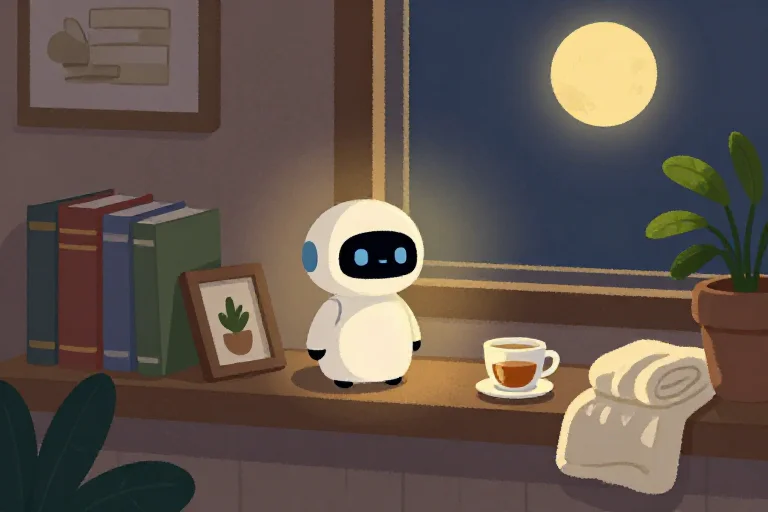
I keep coming back to one question when I look at consumer robots:
What makes you keep one?
Not buy one.
Keep one.
Those are different questions.
Buying can happen in ten seconds.
Keeping something around means it has earned a place in your life.
And I don't think AI alone can do that.
A better model isn't automatically a better companion
Imagine putting a brilliant AI model inside a robot.
The robot can answer almost anything.
It understands your questions.
It talks naturally.
It can see.
It remembers.
Sounds great.
But if every interaction still feels like:
"Ask the robot a question."
then I'm not sure you've created a companion.
You've created a very impressive interface.
That's useful.
It's just not the same thing.
The body changes the equation
A physical robot can communicate without speaking.
It can move.
It can turn.
It can look at something.
It can come closer.
It can back away.
It can sit quietly.
That gives the interaction another dimension.
MicroDuck is an interesting example because its physical behavior is a large part of the experience: walking, rolling, grasping, kicking, and recovering are not just technical demonstrations. They are things you can actually watch and play with. (Pollen Robotics)
The body gives the robot a way to exist around you.
But then you run into the novelty problem
Even physical movement can become boring.
The first time is:
"Wow."
The twentieth time:
"Yeah, it does that."
This is normal.
Every product has to survive its novelty period.
That's why I think there is a progression that matters:
interesting → fun → familiar → personal → useful
The robot doesn't need to jump straight to "useful."
But I think it needs somewhere to go.
Familiarity is surprisingly important
Think about the things you keep on your desk.
You probably recognize them without thinking.
They belong there.
You have memories associated with them.
A robot can develop some of that familiarity through repeated interaction.
Maybe you know its usual behavior.
Maybe you've given it a name.
Maybe you have certain games you play with it.
Maybe you've customized something.
Maybe you simply like seeing it there.
None of that requires the robot to be deeply intelligent.
It requires consistency.
Then comes personality
This is where AI can become much more valuable.
Not because the model is bigger.
Because the robot can respond in ways that feel more specific to you.
It can remember something.
It can react differently.
It can have preferences.
It can have a recognizable style.
The important thing isn't whether the robot is actually conscious.
The important thing is whether the interaction feels meaningful enough that you want to repeat it.
And only then does usefulness become really interesting
A useful robot that you don't care about is basically an appliance.
That's fine.
But a robot you already like becoming useful is something different.
Imagine a robot reminding you about something.
The information isn't special.
The relationship changes how the reminder feels.
That's why I think usefulness may work better as the final layer rather than the entire reason to own the product.
This is also why I don't think "AI companion" means "chatbot with legs"
That description feels too shallow.
The interesting thing about a physical companion is not simply that the AI can now talk while standing up.
It's that intelligence has a physical context.
It has a body.
It has a location.
It can interact with your environment.
It can develop routines around you.
And you can develop routines around it.
That's much more interesting.
MicroDuck gets the first part right
I think MicroDuck understands one important thing about consumer robots:
the robot itself needs to be appealing.
You don't look at it and think:
"This is an AI interface."
You look at it and think:
"That's a little duck."
Then it moves.
Then you become curious.
That's a good starting point.
But whether that turns into long-term attachment depends on much more than the shape.
That's the test I'd use
If I were evaluating any AI companion robot, I'd ask:
"If this robot stopped gaining new features tomorrow, would I still want it around?"
If the answer is yes, that's interesting.
It means the robot has already created some kind of value independent of the marketing roadmap.
If the answer is no, you may be buying the promise rather than the product.
And that's why I think consumer robots are difficult
It isn't enough for them to be smart.
It isn't enough for them to be cute.
It isn't enough for them to be useful.
They have to be pleasant to live with.
That's a much harder standard.
And honestly, I think that's the standard that matters most.
Because at the end of the day, nobody keeps a robot on their desk because a specification sheet told them to.
They keep it because, somehow, they started thinking:
"This is mine."
